
Tracking Quotations on Christianity and Judaism
Finding the Citation

Due to recent geopolitical developments, it has been pointed out to me by my acquaintance Ethan Chan that several quotes concerning the relationship of Christians to Jews have been floating around. These quotes, as so many online, bear no attribution to a text, and their form is curiously brief, and to the point; often a sign of fabrication of paraphrase. I’m pleased to report the two “quotes” presented here, from Ignatius of Antioch and from Justin Martyr are actually paraphrases, unlike the fabricated quote attributed to Symeon the New Theologian I previously covered.
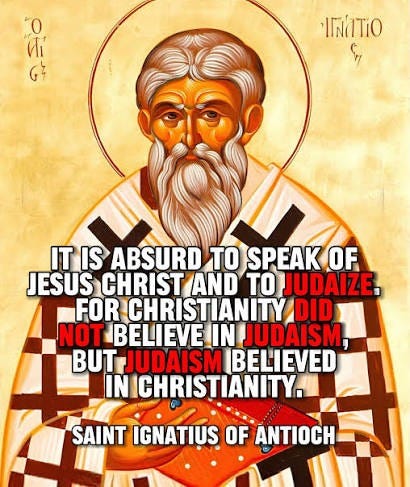
We’ll start with Ignatius of Antioch, and this paraphrase seems to be coming from the Saint’s Letter to the Magnesians.
One of the primary topics of this letter, much like Paul’s letter to the Galatians, is to combat Christians who believe they must adopt Jewish customs to be authentically Christian. This notion, the Judaizing heresy, often held that one needed to participate in circumcision, Jewish dietary and sumptuary laws, and other practices in order to practice Christianity, even as a gentile convert. The Apostles themselves had some initial disputes on the matter, ultimately coming to agreement in the council of Jerusalem recorded in Acts 15. Clearly the issue was still a living controversy at St. Ignatius’ time, almost a century later. Ignatius is very clear: Christianity supersedes Judaism and calls all, Jew or Gentile, to believe on the one name of Jesus Christ.
Here is the relevant section, Ch. 10 of the Letter to the Magnesians, in English translation:
Let us not, therefore, be insensible to His kindness. For were He to reward us according to our works, we should cease to be. Therefore, having become His disciples, let us learn to live according to the principles of Christianity. For whosoever is called by any other name besides this, is not of God. Lay aside, therefore, the evil, the old, the sour leaven, and be changed into the new leaven, which is Jesus Christ. Be salted in Him, lest any one among you should be corrupted, since by your savour you shall be convicted. It is absurd to profess Christ Jesus, and to Judaize. For Christianity did not embrace Judaism, but Judaism Christianity, that so every tongue which believes might be gathered together to God.
When searching for the corresponding Greek text I ran into an interesting problem, though. Some of the texts I found read like this:
X (10) 1. Μη ουν αναισθητώμεν της χρηστότητος αυτού. εάν γαρ ημάς μιμήσηται καθά πράσσομεν, ουκέτι εσμέν. δια τούτο, μαθηταί αυτού γενόμενοι, μάθωμεν κατά Χριστιανισμόν ζήν. ος γαρ άλλω ονόματι καλείται πλέον τούτου, ουκ έστιν του θεού. 2. υπέρθεσθε ουν την κακήν ζύμην, την παλαιωθείσαν και ενοξίσασαν, και μεταβάλεσθε εις νέαν ζύμην, ό εστιν Ιησούς Χριστός. αλίσθητε εν αυτώ, ίνα μη διαφθαρή τις εν υμίν, επεί από της της οσμής ελεγχθήσεσθε. 3. άτοπόν εστιν, Ιησούν Χριστόν λαλείν και ιουδαίζειν. ο γαρ χριστιανισμός ουκ εις Χριστιανισμόν, ω πάσα γλώσσα πιστεύσασα εις θεόν συνήχθη.
The above text, however, is missing some of the key ideas about Judaism believing on Christianity rather than the other way around, instead presenting the odd phrase that “Christianity is not unto Christianity.” I found the oddity present in the above website, and in another version hosted on Christian Ethereal Classics Library here.
In further research, I discovered a fuller quotation in the Loeb Classical Library edition (available on archive websites or direct from the publisher). Which runs as follows:
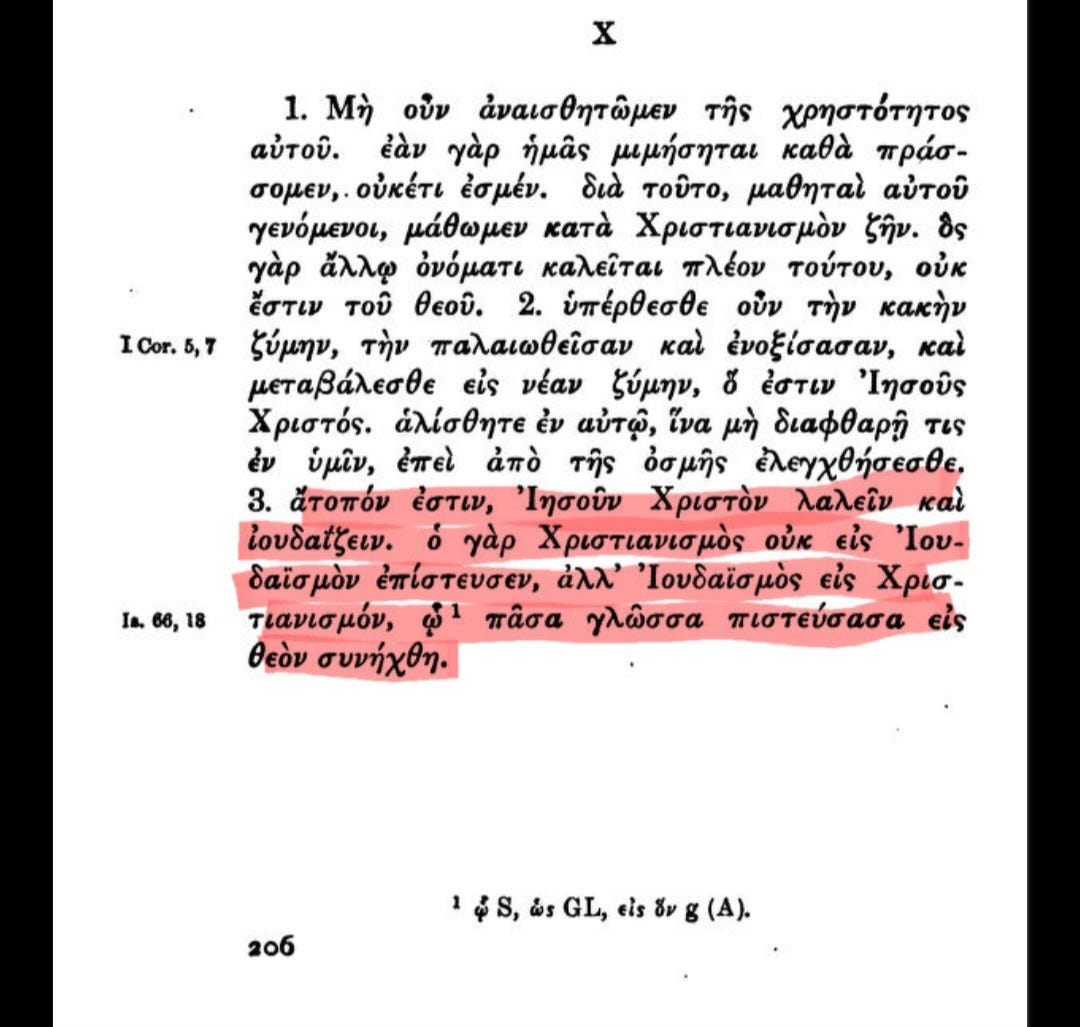
The majority of English translations (in my brief survey) follow the fuller thought as presented above in Loeb. It is more than likely some kind of typographical error, as the sense is greatly hampered. However, it might not be simply a mistake, because I discovered the manuscript history of the Epistles of St. Ignatius is somewhat complicated, and so these variations may come from different exemplars of the text.
As a brief aside, manuscripts often come in “families” following a similar form of a text, called a recension. The manuscripts within a family are called exemplars of that family. So for example you might have an A and a B version of a text, and a particular copy, let’s call it the X Codex, may be an exemplar of A. In the case of Ignatius, there are so-called “longer” and “shorter” recensions in different manuscripts, with witnesses in Greek as well as other languages. The Longer recension includes more texts, some of which are generally deemed spurious, with possible added lines (called interpolations), while the shorter includes fewer texts. When scholars go to publish a text they usually make a “critical” edition, trying to compare manuscripts to get the least spelling mistakes, get to the most accurate reading (as judged between texts), the most original or oldest, etc.
So, in the above case, not being nearly well informed enough on the subject, I simply don’t know whether this is a copyist error (though I think it probable) or whether the editors of the two texts are making different choices based on the differing manuscripts. If you want to read a brief discussion of the manuscript problem in Ignatius, check out the introduction to the texts in the Loeb Classical Library edition of Ignatius’ epistles.
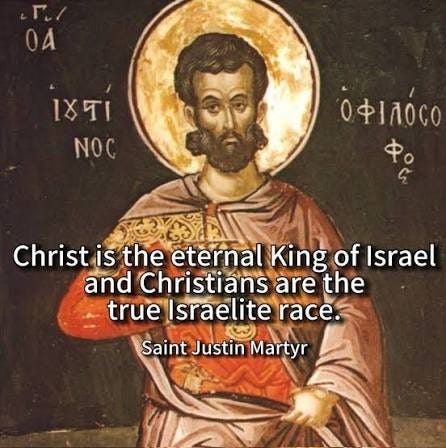
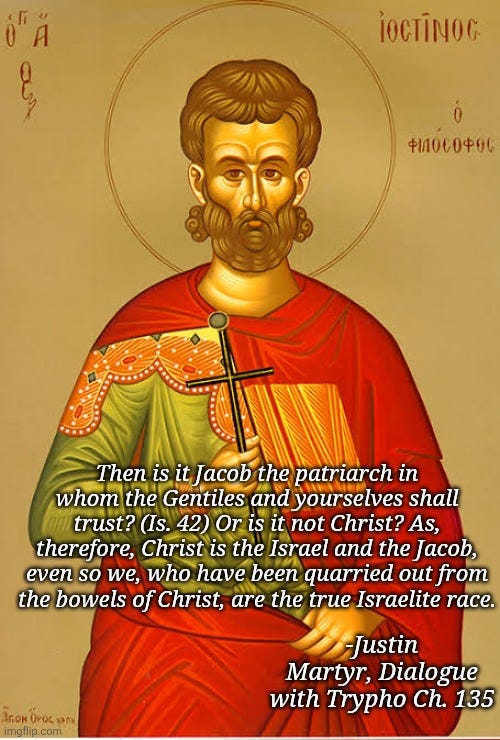
This quote is likewise something of an abbreviated paraphrase from Justin Martyr’s Dialogue with Trypho the Jew, drawing from two separate sentences within the same chapter.
As another brief aside, I will report the following incident in my ongoing foray into use A.I. as a research tool. In searching for the kernel of this quotation I used Microsoft Copilot in the hope of narrowing what I was looking for within the Dialogue with Trypho. In the process I discovered the A.I. sometimes confuses editorial subtitles for part of the text! That said, copilot did help narrow the search significantly, and I came to what I think to be the origin of the above paraphrase.
The above comes, I believe, comes from Ch. 135 of the Dialogue with Trypho the Jew. I present the relevant chapter here in full, as it provides context to Justin’s argument. St. Justin is here building on his interpretation of the wives of the Patriarch Jacob in Genesis as representing the Old and New covenants. More specifically he is here focusing on what is meant by the promises made in prophecy to Jacob-Israel. Ultimately, he puts forward the argument that it is to Christ and the children he has begotten (the Christians) to whom the promises apply; adding weight to his overall argument about why the Jews should become Christians. The chapter closes with reference to the Prophecy of Isaiah in order to drive home the importance of faith in Christ (as the true and prophesied Israel of God) to receive the promised blessings.
From Chapter 135 of the Dialogue with Trypho:
Justin: And when Scripture says, ‘I am the Lord God, the Holy One of Israel, who have made known Israel your King,’ Isaiah 43:15 will you not understand that truly Christ is the everlasting King? For you are aware that Jacob the son of Isaac was never a king. And therefore Scripture again, explaining to us, says what king is meant by Jacob and Israel: ‘Jacob is my Servant, I will uphold Him; and Israel is my Elect, my soul shall receive Him. I have given Him my Spirit; and He shall bring forth judgment to the Gentiles. He shall not cry, and His voice shall not be heard without. The bruised reed He shall not break, and the smoking flax He shall not quench, until He shall bring forth judgment to victory. He shall shine, and shall not be broken, until He set judgment on the earth. And in His name shall the Gentiles trust.’ Isaiah 42:1-4 Then is it Jacob the patriarch in whom the Gentiles and yourselves shall trust? Or is it not Christ? As, therefore, Christ is the Israel and the Jacob, even so we, who have been quarried out from the bowels of Christ, are the true Israelitic race. But let us attend rather to the very word: ‘And I will bring forth,’ He says, ‘the seed out of Jacob, and out of Judah: and it shall inherit My holy mountain; and Mine Elect and My servants shall possess the inheritance, and shall dwell there; and there shall be folds of f8locks in the thicket, and the valley of Achor shall be a resting-place of cattle for the people who have sought Me. But as for you, who forsake Me, and forget My holy mountain, and prepare a table for demons, and fill out drink for the demon, I shall give you to the sword. You shall all fall with a slaughter; for I called you, and you hearkened not, and did evil before me, and did choose that wherein I delighted not.’ Isaiah 65:9-12 Such are the words of Scripture; understand, therefore, that the seed of Jacob now referred to is something else, and not, as may be supposed, spoken of your people. For it is not possible for the seed of Jacob to leave an entrance for the descendants of Jacob, or for [God] to have accepted the very same persons whom He had reproached with unfitness for the inheritance, and promise it to them again; but as there the prophet says, ‘And now, O house of Jacob, come and let us walk in the light of the Lord; for He has sent away His people, the house of Jacob, because their land was full, as at the first, of soothsayers and divinations;’ even so it is necessary for us here to observe that there are two seeds of Judah, and two races, as there are two houses of Jacob: the one begotten by blood and flesh, the other by faith and the Spirit.
The Greek text from J. P. Migne, Patrologia Graeca, Vol. 6, here:
Καὶ ὅταν ἡ γραφὴ λέγῃ· Ἐγὼ κύριος ὁ θεός, ὁ
ἅγιος Ἰσραήλ, ὁ καταδείξας Ἰσραὴλ βασιλέα ὑμῶν· οὐχὶ ἀληθῶς τὸν Χριστὸν τὸν αἰώνιον βασιλέα ἀκούσεσθε; καὶ Ἰακὼβ γάρ, ὁ τοῦ Ἰσαὰκ υἱός, ὅτι οὐδέποτε βασιλεὺς γέγονεν, ἐπίστασθε· καὶ διὰ τοῦτο ἡ γραφή, πάλιν ἐξηγουμένη ἡμῖν τίνα λέγει βασιλέα Ἰακὼβ καὶ Ἰσραήλ, οὕτως ἔφη· Ἰακὼβ ὁ παῖς μου, ἀντιλήψομαι αὐτοῦ· καὶ Ἰσραὴλ ὁ ἐκλεκτός μου, προσδέξεται αὐτὸν ἡ ψυχή μου. δέδωκα τὸ πνεῦμά μου ἐπ’ αὐτόν, καὶ κρίσιν τοῖς ἔθνεσιν ἐξοίσει. οὐ κεκράξεται, οὐδὲ ἀκουσθήσεται ἔξω ἡ φωνὴ αὐτοῦ· κάλαμον τεθραυσμένον οὐ συντρίψει καὶ λίνον τυφόμενον οὐ σβέσει, ἕως οὗ νῖκος ἐξοίσει, κρίσιν ἀναλήψει, καὶ οὐ θραυσθήσεται, ἕως ἂν θῇ ἐπὶ τῆς γῆς κρίσιν· καὶ ἐπὶ τῷ ὀνόματι αὐτοῦ ἐλπιοῦσιν ἔθνη.
μήτι οὖν ἐπὶ τὸν Ἰακὼβ τὸν πατριάρχην οἱ ἀπὸ τῶν ἐθνῶν ἐλπίζουσιν, ἀλλ’ οὐκ ἐπὶ τὸν Χριστόν, καὶ ὑμεῖς δὲ αὐτοί; ὡς οὖν Ἰσραὴλ τὸν Χριστὸν καὶ Ἰακὼβ λέγει, οὕτως καὶ ἡμεῖς ἐκ τῆς κοιλίας τοῦ Χριστοῦ λατομηθέντες Ἰσραηλιτικὸν τὸ ἀληθινόν ἐσμεν γένος. αὐτῷ δὲ μᾶλλον τῷ ·ητῷ προσέχωμεν. Καὶ ἐξάξω, φησί, τὸ ἐξ Ἰακὼβ σπέρμα καὶ ἐξ Ἰούδα· καὶ κληρονομήσει τὸ ὄρος τὸ ἅγιόν μου, καὶ κληρονομήσουσιν οἱ ἐκλεκτοί μου καὶ οἱ δοῦλοί μου, καὶ κατοικήσουσιν ἐκεῖ· καὶ ἔσονται ἐν τῷ δρυμῷ ἐπαύλεις ποιμνίων, καὶ φάραγξ Ἀχὼρ εἰς ἀνάπαυσιν βουκολίων τῷ λαῷ οἳ ἐζήτησάν με. ὑμεῖς δέ, οἱ ἐγκαταλείποντές με καὶ ἐπιλανθανόμενοι τὸ ὄρος τὸ ἅγιόν μου καὶ ἑτοιμάζοντες τοῖς δαιμονίοις τράπεζαν καὶ πληροῦντες τῷ δαίμονι κέρασμα, ἐγὼ παραδώσω ὑμᾶς εἰς μάχαιραν· πάντες σφαγῇ πεσεῖσθε ὅτι ἐκάλεσα ὑμᾶς καὶ οὐχ ὑπηκούσατε, καὶ ἐποιήσατε τὸ πονηρὸν ἐνώπιόν μου, καὶ ἃ οὐκ ἐβουλόμην ἐξελέξασθε. καὶ τὰ μὲν τῆς γραφῆς ταῦτα· συννοεῖτε δὲ καὶ αὐτοὶ ὅτι ἄλλο τί ἐστι τὸ ἐξ Ἰακὼβ σπέρμα νῦν λεγόμενον, οὐχ ὡς οἰηθείη τις ἂν περὶ τοῦ λαοῦ λέγεσθαι. οὐ γὰρ ἐνδέχεται τοῖς ἐξ Ἰακὼβ γεγεννημένοις ἀπολιπεῖν ἐπείσαξιν τοὺς ἐξ Ἰακὼβ σπαρέντας, οὐδὲ ὀνειδίζοντα τῷ λαῷ ὡς μὴ ἀξίῳ τῆς κληρονομίας, πάλιν, ὡς ὑπο λαβόμενος, τοῖς αὐτοῖς ὑπισχνεῖσθαι. καὶ τὰ μὲν τῆς γραφῆς ταῦτα· συννοεῖτε δὲ καὶ αὐτοὶ ὅτι ἄλλο τί ἐστι τὸ ἐξ Ἰακὼβ σπέρμα νῦν λεγόμενον, οὐχ ὡς οἰηθείη τις ἂν περὶ τοῦ λαοῦ λέγεσθαι. οὐ γὰρ ἐνδέχεται τοῖς ἐξ Ἰακὼβ γεγεννημένοις ἀπολιπεῖν ἐπείσαξιν τοὺς ἐξ Ἰακὼβ σπαρέντας, οὐδὲ ὀνειδίζοντα τῷ λαῷ ὡς μὴ ἀξίῳ τῆς κληρονομίας, πάλιν, ὡς ὑπολαβόμενος, τοῖς αὐτοῖς ὑπισχνεῖσθαι. ἀλλ’ ὅνπερ τρόπον ἐκεῖ φησιν ὁ προφήτης· Καὶ νῦν σὺ οἶκος τοῦ Ἰακώβ, δεῦρο καὶ πορευθῶμεν ἐν φωτὶ κυρίου· ἀνῆκε γὰρ τὸν λαὸν αὐτοῦ, τὸν οἶκον Ἰακώβ, ὅτι ἐπλήσθη ἡ χώρα αὐτῶν, ὡς τὸ ἀπ’ ἀρχῆς, μαντειῶν καὶ κληδονισμῶν· οὕτω καὶ ἐνθάδε δεῖ νοεῖν ἡμᾶς δύο σπέρματα Ἰούδα καὶ δύο γένη, ὡς δύο οἴκους Ἰακώβ, τὸν μὲν ἐξ αἵματος καὶ σαρκός, τὸν δὲ ἐκ πίστεως καὶ πνεύματος γεγεννημένον.
In both of the paraphrases, we legitimately see part of the argument each of these saints was making: that the promises God made to Israel through the prophets properly belong to the Christians, and that Jewish worship and belief as it existed under the Old Covenant is no longer sufficient to be called a true believer in the God of Abraham, Isaac, and Jacob. The emphasis given, however, somewhat blunts the overall message by making the statements triumphalistic, without the necessary context of prophetic fulfillment through Christ.
These memes are quite probably aimed at the “Judaeo-Christian” thesis of many Protestant Christians, who hold, under various theologies and ideologies, the notion that God’s promises to the Jewish nation still hold, in their original form, as binding and offering the same blessed fulfillment today, without having to believe on Christ. Likewise, within that notion, there is often a belief that a continuing, religious Jewish population is absolutely necessary, in alliance with the Christians, to bring about the second coming of Christ. I’m honestly not very well informed about the history of these notions, and what I have presented may be in some ways a misrepresentation based on observation of popular media on the subject.
In any case, it is the abiding teaching of the Orthodox Christian Church that she is the New Israel of God, that participation in the new covenant in Christ is the means to salvation, and that by no other name are we saved except by the name of the Lord Jesus Christ.
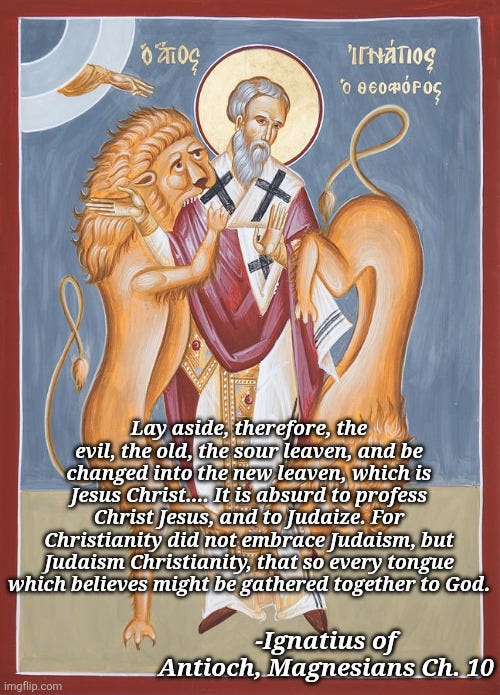
I do however wish these punchy quotes would run at least a little longer in order to preserve their full sense, and would cite their source, and so here are my two amateurish attempts to make those corrections:
This is a great subject, hope you keep doing more articles like this.
Also, I don’t read greek so whats the textual difference between that section in Ignatius’s letter?